

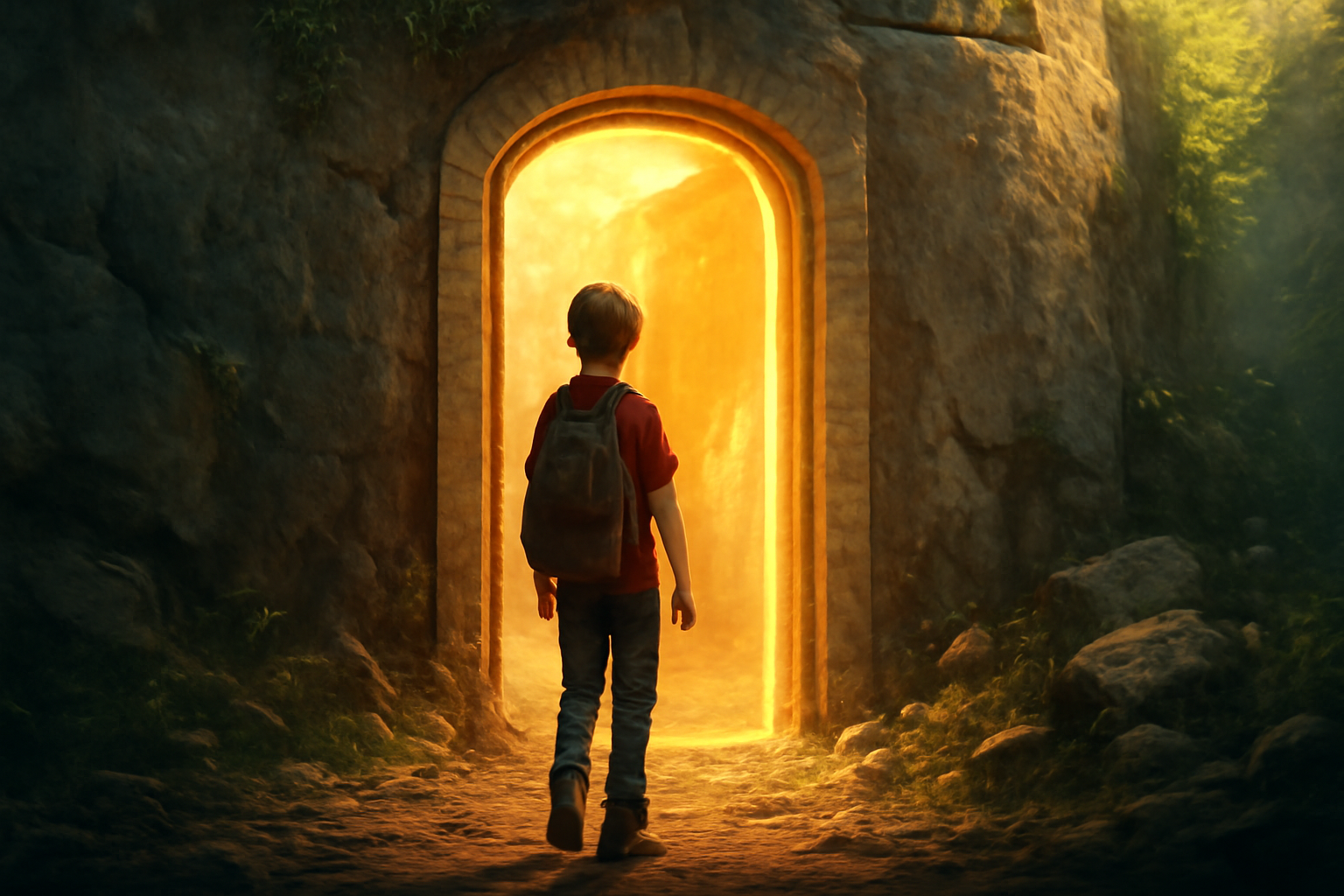
The first time Milo saw the doorway, he thought it was just a crack in the rock.
The hillside behind his grandparents’ house had always been his kingdom — a scruffy, sunburned slope of stone and scrubby grass, dotted with stubborn wildflowers and the occasional lizard that regarded him with lazy disdain. He’d grown up here, in summers and weekends, scrambling up the path with a stick for a sword and his imagination for company.
But today the hill felt different.
He couldn’t have said why. The sky was the same soft blue. The air still smelled of dust and honeysuckle. The cicadas still buzzed lazily in the heat. Yet Milo’s skin prickled with the sense that something was watching him — not in a scary way, just… waiting.
He clambered higher than usual, past the flat rock where he liked to sit and draw, past the gnarled tree that looked like it was perpetually stretching, until he reached an outcrop he’d never paid much attention to.
It was nothing special. Just a slab of stone leaning against the hill, forming a shallow, shadowed alcove.
Except the crack.
At first, he saw only a dark vertical line in the stone. But when he squinted, he realized it wasn’t random. It was shaped like a doorway — tall and narrow, with an arch at the top, edges just slightly too straight to be nature’s work.
Something fluttered inside his chest.
He dropped his backpack and stepped closer.
The air grew cooler as he approached. A strand of cobweb trembled at the edge of the crack, though there was no wind.
Milo reached out and touched the stone.
It was warm.
He pressed his palm flat.
The crack glowed.
Just for a second — a faint, soft light, like the last ember of a campfire.
He yanked his hand back, heart racing.
“Okay,” he whispered. “That’s new.”
He glanced down the hill. His grandparents’ house sat in its familiar spot, small and solid, smoke drifting from the chimney. His grandma would be making tea. His granddad would be pretending not to feed crumbs to the birds.
Normal.
He looked back at the crack.
It glowed again. Not bright. Not blinding. Just… inviting.
A thin line of gold, pulsing like a heartbeat.
Milo swallowed.
“Are you… a door?” he asked, feeling ridiculous.
The glow brightened.
“Right,” he muttered. “Of course you are.”
He placed his hand on the stone again.
This time, he pushed.
The stone didn’t resist.
It flowed.
Like water remembering it had once been river, the rock softened and parted, folding itself aside in slow, graceful ripples. The crack widened, stretching into a tall doorway made of light and shadow.
Beyond it, he saw something impossible.
A street.
And a sky that wasn’t the sky above his hillside.
Milo’s breath caught.
On the other side of the doorway, the world glowed with a gentle, golden dusk — even though it was still midday where he stood. Buildings of smooth, pale stone lined a wide street paved with something that shimmered like moonlit sand. Trees with silver leaves swayed in a wind he couldn’t feel. And in the air, like a faint layer of music beneath everything, was a sound.
A hum.
Soft and steady, like distant voices singing a wordless song.
He took a step forward, heart thudding so hard he could feel it in his fingertips.
The doorway waited.
“Milo!”
His grandmother’s voice floated faintly up the hill.
“Lunch!”
He froze, one foot half-raised.
The doorway’s glow dimmed, as if holding its breath.
Milo glanced back toward the house, then toward the impossible street, torn in two directions.
“I’ll come back,” he whispered to the light.
The doorway’s golden edge flickered once, as if in agreement.
The stone slowly slid back into place, the crack shrinking until it looked like nothing more than a line in old rock.
Milo stood there for a long moment.
Then he grabbed his backpack and ran down the hill, heart racing ahead of his feet.
At lunch, he barely tasted the soup his grandmother set in front of him.
“Everything alright, love?” she asked, peering at him over her glasses.
“Yeah,” he said too fast. “Just… thinking.”
She gave him the sort of look only grandmothers can, the kind that says I know that’s not the whole story, but I’ll wait until you’re ready.
“Your granddad’s in the shed,” she said instead. “Fiddling with that old clock again.”
Milo’s mind flashed back to the doorway. The strange world beyond. The feeling in his chest like something waking up.
“Grandma,” he blurted, “did you ever… find anything weird on the hill?”
She arched an eyebrow. “Weird how?”
“Like… a door. In the stone.”
Her spoon froze halfway to her mouth.
Just for a heartbeat.
Then she shrugged and took a sip.
“There are lots of stories about that hill,” she said lightly. “When I was a girl, people said the rocks up there remember old things.”
“Old things?”
“Old times. Old places.” She smiled, distant and fond. “Old versions of ourselves.”
Milo’s heart skipped.
“Is it dangerous?” he asked quietly.
Her eyes softened.
“It depends what you’re running from,” she said. “And what you’re running toward.”
He frowned. “That’s not an answer.”
“It’s the only one I’ve got,” she replied. “For now.”
She reached over and squeezed his hand.
“Eat your soup.”
He couldn’t stay away.
That afternoon, while his granddad napped and his grandmother hummed in the kitchen, Milo slipped back up the hill.
The stone slab waited, ordinary in the sunlight. The crack was there, thin and dark.
He took a deep breath.
“Okay,” he told his thudding heart. “Let’s try this again.”
He placed his hand on the rock.
Warm.
The crack glowed.
The stone parted.
And the doorway opened.
This time, he did not hesitate.
He stepped through.
It was like walking through cool water that somehow didn’t make you wet.
For a second, everything was bright and weightless — and then his feet landed on solid ground.
The air felt different here — softer, thicker with some kind of quiet energy that hummed along his skin.
He turned in a slow circle.
The street was empty, but not abandoned. Lamps waited unlit along the path, carved with swirling designs that reminded him of growing vines. Windows stood open in buildings the color of shells. Somewhere far off, he heard laughter.
“Milo Wynn,” a voice said behind him.
He jolted so hard he almost fell.
Standing there, under the archway of the doorway — which now appeared as just another carved stone portal in a wall — was a woman.
She looked young and old at the same time. Her hair was braided with tiny metal charms that chimed when she moved. Her eyes were dark and kind, and when she smiled, he felt something inside him relax, like a knot untangling.
“You remember me,” she said.
“I’ve never seen you before,” Milo stammered.
Her smile didn’t falter.
“Not with these eyes,” she said. “Not in this life.”
He blinked. “In this what?”
She tilted her head. “You don’t remember yet. That’s alright. The world will help.”
She gestured to the street.
“Walk with me?”
He hesitated. “Who are you?”
“A friend,” she said simply. “My name is Sera. I live here. And you… used to.”
He stared.
“I used to what?”
“Live here,” she repeated gently. “In Aramelle. The city between times.”
“That’s not possible,” Milo said, but the argument sounded weak even to him.
Sera’s eyes softened.
“Milo,” she said quietly, “how many times have you dreamt of this place?”
He opened his mouth.
Stopped.
Thought of the dreams he’d had for as long as he could remember — dreams of glowing streets, silver-leafed trees, a sky that was always dusk. He’d thought they were just that: dreams.
He’d even drawn them, pages and pages in worn sketchbooks.
His cheeks warmed.
“A lot,” he admitted.
She reached out with that same gentle smile.
“Then come see why.”
They walked.
The city unfurled around them like a memory resurfacing.
Aramelle was beautiful — not in a glossy, fantasy-book way, but in a lived-in warmth. The buildings curved as if grown rather than built. Murals flowed across walls in colors Milo had no names for. People moved through the streets with an easy, unhurried grace, each glance curious but not unfriendly.
Some nodded at him as they passed.
Some smiled.
One old man raised a hand and called, “Back again, are you?” before being shushed by a companion.
Milo frowned. “They know me?”
Sera nodded. Little charms in her braids chimed softly.
“You were born here, once,” she said. “A long time ago, by your world’s measure. You were a mapmaker. You drew doorways. Paths. Ways through.”
“I’m just a kid,” Milo protested.
“You’re more than one thing,” she said. “More than one time.”
He stared at his hands.
“Why don’t I remember?”
“You do,” she said. “Just not with your head yet. The remembering starts here.” She touched his chest, gently, over his heart. “The rest catches up.”
They reached a wide plaza where a fountain sang water into the air. Instead of statues, it held shifting shapes of light — scenes that changed when you blinked.
Milo saw flashes of places he knew — his grandparents’ house, his school, the grocery store on the corner — mixed with places he didn’t: vast forests under strange constellations, cities perched on cliffs that glowed like fireflies.
“What is this place?” he breathed.
“Between,” Sera said. “This is where worlds touch. Where times that have ended and times yet to come leave echoes.”
“And… me?” Milo asked softly. “What am I?”
Sera looked at him with such kindness it made his eyes sting.
“You,” she said, “are someone who’s walked more paths than you remember. Someone who builds bridges without knowing it. Someone who, when they find a door in stone, still chooses to knock.”
He swallowed. “That doesn’t… sound like much.”
“It’s everything,” she said.
He watched the fountain for a while, trying to make his thoughts fit into a shape that made sense.
“So why now?” he asked finally. “Why am I here again?”
Sera’s face grew more serious.
“Because Aramelle remembers those who leave,” she said. “Especially when they leave unfinished.”
“Unfinished what?”
“Promises,” she said simply.
Something inside him lurched.
“What kind of promises?”
She touched one of the charms in her hair. It glowed softly at her fingertips.
“When you were here before,” she said, “you loved this city. You helped people find their way. And when you left — when your path went on to other places, other lives — you promised to come back when the door opened again.”
He shook his head slowly. “I don’t… remember promising that.”
Sera smiled gently.
“Does that make it less true?”
He thought of the crack in the stone. The way his chest had felt when it opened. The instant certainty that he had to step through.
“No,” he admitted.
Sera’s smile brightened.
“Then you understand more than you think.”
They spent what felt like hours exploring Aramelle.
Sera showed him a library where books wrote themselves from thoughts unspoken. A garden where plants changed color based on the stories you told them. A small tower where people sat in silence, listening to other worlds breathe.
Everywhere they went, Milo felt a strange, bittersweet familiarity — like visiting a childhood home after years away and realizing you still know exactly where the loose floorboard is.
When they stopped to rest under a tree with glimmering leaves, he asked:
“Why did I leave?”
Sera watched a leaf drift down, glowing faintly as it fell into her hand.
“Because paths go on,” she said. “No one stays in one world forever. Not even here.”
“Did I… die?” he whispered.
“Not in the way your world fears,” she said. “You moved. Like water into new shapes. New neighborhoods of time.”
He thought about his life — about school and bikes and his parents’ quiet arguments and his grandmother’s stories. About how sometimes, even on perfectly ordinary days, he’d feel a weird ache in his chest, as though he’d forgotten something important and couldn’t name what.
“Did you miss me?” he asked before he could stop himself.
Sera looked at him like the question hurt and healed at the same time.
“Every day,” she said simply.
His throat tightened.
“I don’t remember you,” he whispered.
“You will,” she replied. “In pieces. In feelings. In the way your feet know how to walk these streets without thinking.”
He realized, with a jolt, that she was right. He hadn’t once needed to ask for directions.
The thought was both terrifying and comforting.
“How long can I stay?” he asked.
Sera’s gaze flicked to the sky — still that timeless dusk.
“Long enough,” she said. “But not forever.”
“Because I have to… grow up?” he guessed.
“Because you have to live,” she corrected softly. “Really live. There are people waiting for you. Version of you that hasn’t been written yet.”
He sighed, feeling strangely old and young all at once.
“What happens when I go back?” he asked. “Will I forget this?”
“Not this time,” she said. “This time the remembering is meant to stick.”
He looked at her.
“You talk like you know the story already.”
She smiled a little sadly.
“I remember the last one,” she said.
When it was time to go, he knew.
The light in the streets shifted just a shade. The air felt like a held breath about to be released.
Sera walked with him back to the stone archway that marked the boundary between Aramelle and the rocky hillside of his world.
He stood in front of it, hand resting on the cool carved stone.
“Will I see you again?” he asked softly.
Sera reached up and gently placed one of the glowing charms from her braid into his palm. It flickered, then settled into the shape of a tiny stone doorway.
“You already have,” she said. “In every lifetime. Just not always with this face.”
He closed his fingers around the charm.
“And next time?” he whispered.
She smiled — that same warm, steady smile.
“Next time,” she said, “maybe you’ll be the one waiting on this side when I find the door.”
Something in his chest answered yes without asking his permission.
He stepped forward.
The doorway breathed light around him.
The world folded.
He stumbled back onto the hillside, the afternoon sun sharp in his eyes, cicadas shrilling as if nothing extraordinary had happened at all.
Except the rock.
The crack was there. Thin. Ordinary-looking.
He touched it.
Cold stone.
No glow.
No doorway.
Not right now.
But in his hand, the tiny charm still pulsed faintly — warm, like a heartbeat that wasn’t quite his.
Down the hill, his grandmother called his name for dinner.
Milo tucked the charm into his pocket.
He walked back to the house slowly, feeling the weight of two worlds in his bones, both real, both his.
His grandma met him at the door, taking one look at his face and raising an eyebrow.
“Long day?” she asked.
He managed a wobbly smile.
“You have no idea.”
She chuckled softly. “Oh, I might.”
He blinked. “What?”
She just patted his cheek.
“Eat first,” she said. “Cosmic revelations go down better with stew.”
That night, lying in bed in the small guest room, Milo turned the little doorway-stone over and over in his fingers.
He could still hear the hum of Aramelle in his memory, feel the warmth of Sera’s hand, see the glow of the fountain and the shifting sky.
He had not imagined it.
He knew that now with a certainty deeper than logic.
Somewhere, beyond stone and time, a city remembered him.
And he — finally — remembered it back.
As he drifted toward sleep, the charm warmed against his skin, and a familiar voice — Sera’s — seemed to brush his thoughts like a breeze:
Live well.
Draw your paths.
We’ll meet at the next door.
Milo smiled into his pillow.
For the first time in a long time, the future didn’t feel like a blank page.
It felt like a doorway.
Waiting to be found.